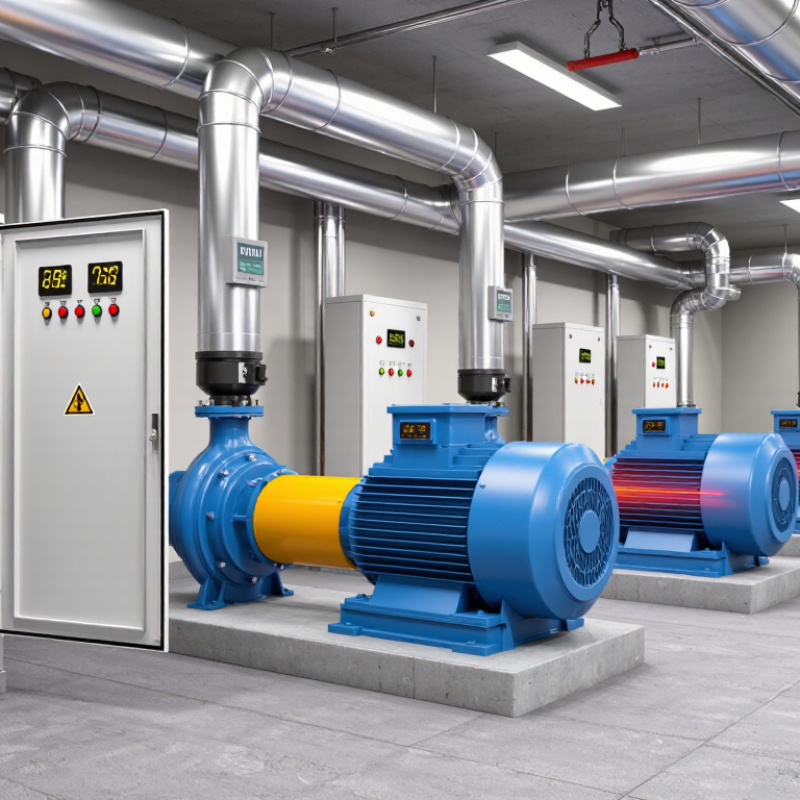
Industrial Frequency Converters help match motor speed to the work a machine actually needs. In a pump room, that can mean slowing a motor when demand falls instead of regulating flow with a partly closed valve. The practical choice, however, depends on more than rated power. Load profile, supply voltage, operating environment, control method, and maintenance capacity all matter. Small mismatches can become persistent costs.
The scale is significant. The International Energy Agency has reported that electric motor systems account for around 46% of global electricity consumption, highlighting why motor efficiency deserves careful attention. This figure covers motor systems broadly; it is not a forecast of savings from converters alone. The U.S. Department of Energy’s motor-system guidance likewise emphasizes assessing the whole application, including the driven equipment and operating conditions. A converter cannot correct an oversized pump or poor control logic by itself. Worth remembering.
A sound selection starts with the motor nameplate and real operating data: voltage, current, frequency, speed range, and hours under load. Check whether the application needs constant torque, variable torque, braking, or precise speed control. Then compare enclosure ratings, cooling, harmonic considerations, communications, and service support. These details are easy to overlook. Manufacturer specifications and a qualified application review provide firmer evidence than headline efficiency claims. The best Industrial Frequency Converters are not simply the largest or most advanced units; they are correctly matched to the duty, installation, and people who will maintain them. One caveat remains: actual energy savings vary with the system and its use.
How to Choose Industrial Frequency Converters?
Defining the application is the practical starting point for choosing an industrial frequency converter. A pump, conveyor, compressor, and heating system create different electrical demands. Record the motor’s rated power, voltage, current, frequency, and phase configuration. Do not rely on horsepower alone. It can mislead.
Study the load during starting, acceleration, normal operation, and stopping. A conveyor carrying heavy material may require high starting torque. A fan usually needs smoother speed control and energy-efficient operation. Check whether the converter must control one motor or several motors. Confirm the required speed range, overload capacity, braking method, and response time. Small details matter.
Environmental conditions also shape the specification. Measure ambient temperature, humidity, dust, vibration, and installation altitude. A converter installed beside a furnace may need thermal derating. A dusty workshop may require a protected enclosure and improved cooling. Input voltage fluctuations and power quality deserve attention too. Harmonic limits, electromagnetic compatibility, and control-panel space should be reviewed before purchase.
I have seen projects fail because the converter was selected from motor size only. The machine ran, but acceleration was unstable and protection triggered repeatedly. That mistake was avoidable. Gather real operating data, not assumptions. Speak with the equipment manufacturer, electrician, and maintenance team. Their observations may expose brief overloads or unusual stopping cycles. Requirements can remain incomplete. Recheck them during commissioning.
| Selection Dimension | Typical Requirement | Recommended Specification or Decision Rule | Why It Matters |
|---|---|---|---|
| Industrial Application | Pumps, fans, conveyors, compressors, mixers, machine tools, or hoists | Classify the load as variable-torque, constant-torque, or high-inertia duty before selecting the converter. | Load type determines the required overload capacity, control method, braking arrangement, and motor-sizing margin. |
| Load Torque Profile | Variable torque for centrifugal pumps and fans; constant torque for conveyors and positive-displacement equipment | Use a variable-torque rating for centrifugal loads and a heavy-duty or constant-torque rating for demanding mechanical loads. | Variable-torque applications generally require less starting torque, while constant-torque loads can demand full torque at low speed. |
| Motor Power | Common industrial motor ratings from approximately 0.75 kW to several hundred kilowatts | Match the converter to the motor's rated current, not only its nameplate power. Use the converter's continuous output-current rating as the primary check. | Motor power varies with voltage, efficiency, power factor, and duty. Current-based sizing helps prevent thermal overload. |
| Input Voltage | Low-voltage three-phase industrial supplies such as 200–240 V or 380–480 V | Select an input class compatible with the site's nominal voltage and allowable supply tolerance. Confirm whether the source is single-phase or three-phase. | An incorrect voltage class can cause undervoltage trips, overvoltage stress, reduced output capability, or equipment damage. |
| Input Frequency | Usually 50 Hz or 60 Hz, depending on the electrical system | Choose a converter that supports the local line frequency and configure the motor's rated frequency according to its nameplate. | Correct frequency settings are required for accurate motor speed, flux control, and protection functions. |
| Output Frequency Range | Typical operating ranges include 0–50 Hz, 0–60 Hz, or extended ranges above the motor's base frequency | Define the minimum and maximum operating speeds required by the process. Verify motor cooling, bearing limits, and mechanical speed limits. | Low-speed operation can reduce self-cooling, while overspeed operation may exceed the motor or driven machine's safe limits. |
| Required Starting Torque | Low starting torque for fans; medium or high starting torque for conveyors, crushers, mixers, and loaded pumps | For high starting torque, consider sensorless vector control or closed-loop vector control rather than basic volts-per-hertz control. | Improved low-speed torque helps prevent stalled starts and reduces mechanical shock during acceleration. |
| Overload Capacity | Normal duty may require about 110%–120% overload for one minute; heavy duty may require about 150% for one minute | Compare the converter's overload rating and duration with the actual acceleration, impact-load, and cyclic-duty requirements. | Insufficient overload capacity can cause nuisance trips or overheating during starting and temporary load peaks. |
| Speed Regulation | Basic process control, moderate speed stability, or precise speed and torque regulation | Use volts-per-hertz control for simple loads, sensorless vector control for improved regulation, or encoder feedback for high-precision applications. | The control mode affects speed accuracy, low-speed torque, response time, and suitability for synchronized processes. |
| Acceleration and Deceleration | Short ramp times for responsive machinery; longer ramps for high-inertia equipment or fragile products | Specify the required acceleration and deceleration times. Check whether a braking resistor, regenerative unit, or extended ramp is necessary. | Rapid deceleration of high-inertia loads can return energy to the converter's DC bus and cause overvoltage trips. |
| Braking Requirement | Free stopping, controlled ramp-down, dynamic braking, or regenerative braking | For frequent or rapid stops, size the braking resistor and duty cycle using the load inertia, speed, stopping time, and stop frequency. | Correct braking selection controls regenerated energy and prevents excessive DC-bus voltage. |
| Environmental Conditions | Ambient temperatures commonly from approximately −10 °C to 40 °C, with altitude, dust, humidity, and vibration varying by site | Check the converter's temperature, altitude derating, humidity, vibration, and contamination limits. Apply the manufacturer's derating rules above the reference conditions. | Heat, altitude, dust, and vibration can reduce cooling performance and shorten component life. |
| Enclosure Protection | Clean electrical rooms may use low enclosure protection; dusty, wet, or washdown areas require higher protection | Choose an enclosure rating suitable for the installation location, such as a protected cabinet or a higher-rated standalone enclosure where required. | Protection against dust and water reduces the risk of insulation failure, corrosion, and cooling-system blockage. |
| Motor Cable Length | Short cable runs or long runs extending tens or hundreds of meters | For long motor cables, verify allowable cable length and consider an output reactor, dV/dt filter, or sine-wave filter when required. | Fast switching edges and long cables can increase reflected-wave voltage, insulation stress, and electromagnetic interference. |
| Electromagnetic Compatibility | Industrial environments with sensitive instrumentation, communication networks, or medical and laboratory equipment nearby | Evaluate EMC requirements, cable shielding, grounding, cabinet layout, and the need for an input or output filter. | Good EMC design limits conducted and radiated interference that can disturb control systems and communication equipment. |
| Input Harmonics | Facilities with strict power-quality limits or a high concentration of power-electronic loads | Assess the need for line reactors, passive harmonic filters, active front ends, or other harmonic-mitigation equipment. | Harmonic current can increase losses, heat transformers and cables, and affect other loads connected to the same electrical system. |
| Control and Communication | Local keypad control, digital and analog signals, PLC integration, or industrial network control | Confirm the required I/O types, analog signal ranges, safety inputs, relay outputs, and communication protocol compatibility. | Control compatibility determines whether the converter can be integrated into the existing automation architecture. |
| Functional Safety | Applications requiring controlled access, emergency stopping, or prevention of unexpected motor restart | Verify whether the converter provides the required safety functions, such as safe torque removal, and ensure the complete system meets applicable safety requirements. | Safety functions must be evaluated at the system level, including wiring, safety controls, machinery, and operating procedures. |
| Energy-Saving Objective | Variable-flow pumps and fans operating for long periods at reduced demand | Use adjustable-speed control where process demand varies, and compare expected operating points with the motor and pump or fan efficiency curves. | Reducing speed can significantly reduce the power required by centrifugal equipment, but savings depend on the actual duty cycle. |
| Installation and Maintenance | Limited cabinet space, continuous production, or restricted access for service | Check dimensions, ventilation clearance, heat loss, replaceable cooling fans, parameter backup, diagnostics, and spare-parts strategy. | Practical installation and maintainability affect downtime, service cost, and the converter's operating life. |
| Final Selection Check | Complete electrical, mechanical, environmental, control, and safety requirements | Confirm motor current, duty rating, input supply, overload profile, braking, EMC, enclosure, cable length, communications, and derating before purchase. | A complete application definition is more reliable than selecting a converter by motor power alone. |
Engineering note: The values shown are general industrial selection ranges. Final sizing should be verified against the motor nameplate, driven-machine data, site electrical conditions, applicable standards, and the converter manufacturer's technical documentation.
Confirm voltage, phase type, line frequency, available current, and cabinet capacity. A three-phase unit may not suit single-phase equipment.
Power ratings alone can hide current demands. A loaded conveyor may need extra starting torque and overload capacity.
Review frequency resolution, acceleration time, braking response, and feedback options. Sensorless control may struggle at very low speeds.
Check thermal monitoring, phase-loss detection, short-circuit tolerance, and controlled stopping. Dust and washdown water can change the requirements.
Not necessarily. Compare efficiency across the expected speed range, including low-load operation. Cabinet heat can erase energy savings.
Use clear terminals, readable diagnostics, accessible filters, and removable fans. Separate power and signal cables. Document torque settings.
Check applicable electrical requirements, electromagnetic compatibility information, enclosure ratings, test reports, and rating conditions. A 45°C rating may require derating.
Request wiring diagrams, parameter lists, installation guidance, and fault-reset procedures. Confirm technical response times. Phone support can prevent long stoppages.
Include commissioning, cooling, filters, cables, spare parts, energy use, and planned maintenance. A cheaper unit may need frequent fan replacement.
Yes, if possible. Test several operating cycles under real conditions. Laboratory results can miss dusty cabinets, heat, and changing production loads.
Choosing Industrial Frequency Converters begins with a clear understanding of the application, including motor type, load profile, operating environment, and required speed range. The converter’s rated capacity should match the motor’s actual and starting demands, while allowing suitable margin for overloads, temperature changes, and continuous operation. Important specifications include input voltage, output voltage, frequency range, control accuracy, response time, and compatibility with the existing electrical system.
A reliable selection should also consider protection functions, energy efficiency, cooling requirements, installation space, maintenance access, and ease of troubleshooting. Safety and performance can be improved by verifying compliance with relevant technical standards and assessing the supplier’s documentation, technical assistance, spare-parts availability, and warranty service. Finally, compare the total ownership cost rather than focusing only on the purchase price. Installation, energy consumption, maintenance, downtime, and expected service life all contribute to the long-term value of the converter.