1. How do I decide between a Linear AC Power Source and a Switch-Mode PWM Programmable AC Supply?
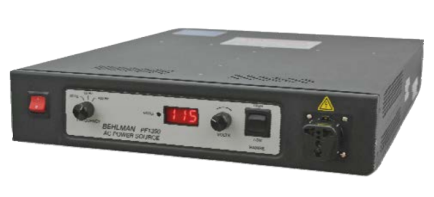
Selecting the optimal topology depends on your target testing parameters. Linear AC Power Supplies use analog transistor amplification. They provide unparalleled signal purity with Total Harmonic Distortion (THD) below 0.1%, extremely low ripple noise, and lightning-fast transient response (<10 µs). They are the gold standard for EMI/RFI sensitive audio equipment testing, medical sensor calibration, and military communication receivers. However, linear units are bulkier and have lower operational efficiency (~45–50%).
Conversely, Switch-Mode PWM Programmable AC Supplies utilize high-frequency switching circuits (such as SiC MOSFETs). They deliver high efficiency (>85–92%), compact 1U/2U/3U rack densities, and cost-effective scalability into multi-kVA and hundred-kVA power systems. Modern PWM AC sources from Powerstax incorporate advanced LC output filters, keeping output THD under 0.3–0.5% under linear loads, making them ideal for commercial EUT testing, grid disturbance simulation, and industrial manufacturing lines.
2. What is Crest Factor, and why is it critical when sizing a Programmable AC Source for non-linear loads?
Crest Factor is the ratio of peak current to root-mean-square (RMS) current ($I_{\text{peak}} / I_{\text{RMS}}$). While a pure sinusoidal AC waveform into a purely resistive load has a crest factor of 1.414 ($\sqrt{2}$), real-world non-linear loads—such as switch-mode power supplies, rectifiers, and motor drives—draw current in sharp, brief high-amplitude pulses, pushing peak crest factors to 3.0:1 or even 4.5:1.
If your programmable AC source cannot supply high peak crest currents without clipping or current-limiting, the output waveform flattens, leading to invalid EUT compliance results and unexpected unit shutdowns. Powerstax programmable AC power supplies are explicitly designed to sustain peak crest factors up to 4:1 at full RMS rating, eliminating waveform distortion during heavy peak-current pulse demands.
3. How do Powerstax programmable AC sources support compliance testing for MIL-STD-704, MIL-STD-1399, and DO-160 section 16?
Defense and commercial avionics equipment must operate reliably under aggressive voltage transients, frequency sags, phase imbalances, and harmonic distortion found in aircraft 400Hz grids and naval shipboard distributions. Powerstax programmable AC supplies feature dedicated software macro suites designed specifically for airborne and naval compliance standards:
- MIL-STD-704F (Airborne Electric Power): Emulates normal, emergency, and abnormal AC voltage transients, frequency swings from 320 Hz to 800 Hz (variable frequency aircraft systems), and emergency DC dropouts.
- DO-160G Section 16: Simulates AC voltage sags, over-voltage spikes, frequency variation, and harmonic immunity for commercial aircraft equipment.
- MIL-STD-1399-300B (Interface Standard for Shipboard Systems): Replicates 60Hz and 400Hz ungrounded shipboard power, voltage dip transients, and phase imbalance spikes.
4. Can Powerstax customize standard AC source platforms for harsh environmental or unique mechanical installations?
Yes. Our Value-Added Engineering team specializes in re-engineering standard platforms to withstand extreme conditions. Capabilities include IP54/IP65 ruggedised industrial cabinets, anti-vibration structural reinforcement for mobile military vehicle deployment, conformal coating of PCB assemblies, extended operating temperature ratings (-40°C to +65°C), liquid-cooled heat exchangers for clean-room installations, and custom digital communications interfaces (such as legacy analog 0-10V control, EtherCAT, or MIL-STD-1553 bus protocol conversion).
5. What key trade-offs should procurement teams evaluate between Monolithic 3-Phase AC Sources and Parallel Modular AC Architectures?
Monolithic 3-phase AC power supplies provide a single integrated enclosure designed for fixed total power requirements (e.g., 45 kVA). They typically offer slightly lower initial capital cost for fixed factory test benches. However, they lack flexibility if power demand grows.
Parallel Modular AC Architectures allow engineers to stack multiple independent AC power modules (e.g., 3 kVA or 5 kVA modules) in parallel to reach up to 120 kVA+. The benefits include: N+1 Redundancy (if one module experiences an anomaly, the remaining modules maintain uninterrupted power to the test load), Field Scalability (purchasing baseline capacity today and adding modules as production scales), and Reduced Mean Time to Repair (MTTR) via hot-swappable module replacement without decommissioning the entire rack system.
6. How does Powerstax guarantee low Total Harmonic Distortion (THD) during Factory Acceptance Testing (FAT)?
Every programmable AC unit designed by Powerstax undergoes stringent multi-stage testing before dispatch. We measure voltage distortion using high-precision digital power analyzers under zero-load, nominal-load, and full reactive non-linear load conditions across the entire frequency range (45Hz – 500Hz). Factory Acceptance Test (FAT) documentation includes harmonic spectrum analysis charts up to 100 kHz, dynamic load step response logs, temperature rise validation, and dielectric safety isolation checks. FAT reports accompany every unit shipped to customer facilities.
7. What long-term maintenance, calibration, and support services are offered by Powerstax?
To ensure long-term operational accuracy and ISO 17025 compliance, Powerstax provides global lifecycle support services including: annual traceable calibration, preventive maintenance inspections, component-level repair, hardware refurbishment programs, and on-site engineer dispatch for commissioning and FAT/SAT sign-offs. Our UK and North American technical teams maintain spare parts inventory for decades-old legacy platforms, protecting your long-term capital investment.