Technical Whitepaper & Industrial Procurement Guide for High-Voltage Diodes, Thyristors, Silicon Stacks, and Heavy-Duty Rectification Electronics
Precision-engineered semiconductor components, silicone stacks, and thyristor modules evaluated for dielectric breakdown strength, thermal dissipation, and industrial reliability.
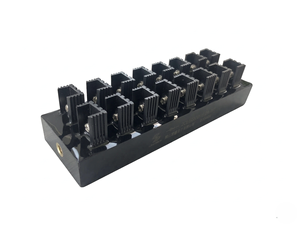
Heavy-duty 20kV high-voltage rectifier block utilizing multi-chip series arrangement housed in high-dielectric epoxy encapsulation. Designed for high-frequency industrial induction heating, electrostatic precipitators, and medical X-ray generators.
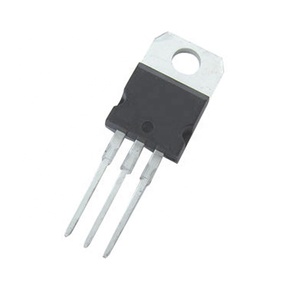
Glass-passivated phase-control thyristor rated for 25A continuous RMS current. Features low thermal resistance, superior dV/dt noise immunity, and high voltage blocking capabilities for AC power switching, motor speed controllers, and solid-state relays.
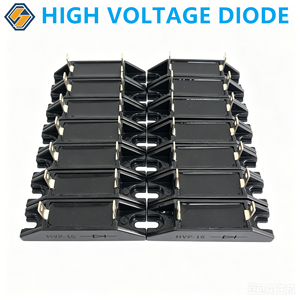
Ultra-fast recovery silicon stack assembly specifically optimized for industrial RF generators, microwave plasma systems, and HF induction heating rectifiers. Features controlled avalanche characteristics and avalanche energy tolerance.
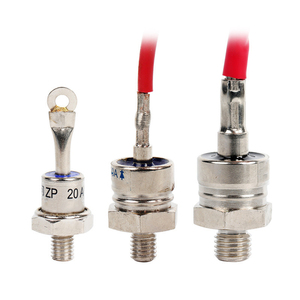
Stud-type high-power silicon diode offering 100A rectifying capacity with chrome-plated copper base. Engineed for severe electroplating power supplies, battery charging equipment, and high-current industrial DC converters.
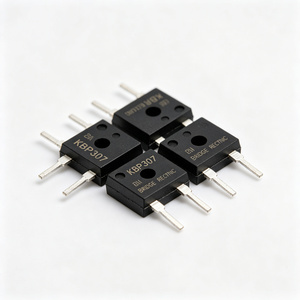
Single-phase compact bridge rectifier encapsulated in flame-retardant UL 94V-0 plastic. High surge current capability (80A peak) makes it ideal for switch-mode power supplies (SMPS), LED drivers, and industrial AC-DC front-ends.
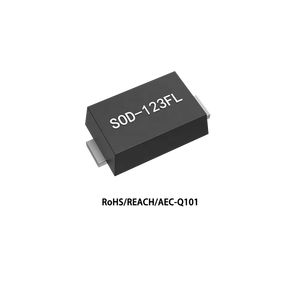
Low-profile SMD rectifier diode featuring 800V breakdown margin in a sub-miniature SOD-123FL package. Supplied with 100% original traceable lot codes for high-density automotive modules and consumer electronics PCB assembly.
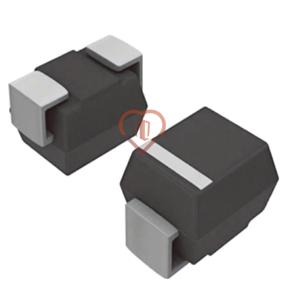
Precision transient voltage suppressor (TVS) designed to safeguard sensitive industrial control lines and consumer electronics against electro-static discharge (ESD) and lightning-induced voltage surges. Ultra-fast response time.
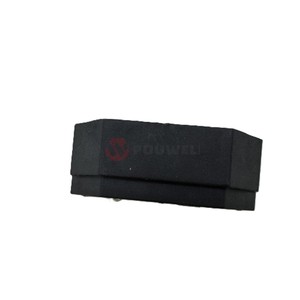
Heavy-duty OEM thyristor brake rectifier module designed for MGM motor drives and crane hoists. Converts 400VAC line input to fast-acting 180VDC excitation for quick mechanical braking release and holding safety.
High-voltage power conversion systems operated in industrial environments face severe electrical stresses, thermal gradients, and electromagnetic transients. When specifying components such as high voltage silicon stacks (HVP-16), encapsulated rectifier blocks (2CLG20KV/50A-WT), or stud-mounted spiral diodes (ZP100A), engineering directors must look beyond static voltage ratings ($V_{RRM}$) and examine junction physics, dielectric passivation, and reverse recovery metrics ($t_{rr}$).
In high-voltage semiconductor design, planar silicon p-n junctions become exceptionally susceptible to localized edge breakdown due to electric field crowding along junction contours. Leading Chinese high-voltage manufacturers mitigate this issue by employing advanced glass passivation pellet technologies and beveling techniques (typically double-bevel angles between $3^\circ$ and $15^\circ$). Glass passivation passivates surface states and stabilizes surface electric fields, preventing premature breakdown and reducing reverse leakage current ($I_R$) to single-digit microamperes even at elevated junction temperatures ($T_j = 150^\circ\text{C}$).
| Topological Parameter | High Voltage Block (2CLG20KV) | Silicon Stack (HVP-16) | Spiral Stud Diode (ZP100A) | SCR Thyristor (TO-220) |
|---|---|---|---|---|
| Target Breakdown ($V_{RRM}$) | 20,000 V | 17,500 V | 1,600 V | 600 V – 1600 V |
| Continuous Current ($I_{F(AV)}$) | 50 A | 1.0 A – 3.0 A | 100 A | 25 A (RMS) |
| Reverse Recovery ($t_{rr}$) | Standard (≈ 1.5 μs) | Ultra-Fast (≤ 100 ns) | Standard Line Freq. | Phase Control Driven |
| Thermal Interface ($R_{\theta JC}$) | Oil/Epoxy Submerged | Forced Air / Heatsink | Direct Threaded Base | TO-220 Metal Tab |
| Primary Application | Electrostatic Filters, HV PSUs | RF Generators, Plasma | Plating, Electrolysis | Motor Drives, Soft Starters |
Furthermore, controlled avalanche characteristics are integrated into assemblies like the HVP-16 stack. When transient overvoltages surpass the rated breakdown threshold, an avalanche-rated diode absorbs substantial reverse energy ($E_{AR}$) across the entire p-n junction area rather than failing via localized filamentary hot-spots. This energy dissipation capability is essential for pulse-power systems, radio-frequency (RF) plasma generators, and microwave heating applications where load arcing frequently reflects destructive transient voltage spikes back into the secondary rectifier bridge.
As a global OEM power engineering powerhouse, our manufacturing infrastructure combines UK legacy design controls with high-scale Chinese semiconductor fabrication capabilities. We deliver power conversion architectures scaled into megawatt electrolysis regimes down to ultra-precise surface-mount components with complete end-to-end traceability.
Every single component—from sub-miniature 1N4006W SOD-123FL surface mount rectifiers to multi-kilowatt thyristor banks—is batch-indexed with 100% original traceable lot codes. Our quality assurance labs mandate 100% dynamic screening for breakdown voltage, leakage current, and thermal impedance before shipment.
High-voltage encapsulated units (such as the 2CLG20KV block) utilize high-vacuum resin degassing and vacuum pressure impregnation (VPI). This eliminates internal micro-voids, guaranteeing partial discharge rates below 5 pC at 120% nominal operating voltage, preventing corona degradation over multi-decade operational lifetimes.
Beyond standard catalog offerings, our value-added engineering team specializes in clean-sheet power architectures. We custom-configure thyristor phase control circuits (e.g., M400 MGM SCR Brake Units), harmonic-filtered transformer rectifiers, and high-frequency pulsed power supplies tailored to exact load curves and environmental parameters.
Our power conversion systems undergo rigorous thermal shock testing ($-40^\circ\text{C}$ to $+125^\circ\text{C}$), high-acceleration stress screening (HASS), and electromagnetic compatibility (EMC) testing compliant with MIL-STD-704, MIL-STD-1275, and IEC/EN 61010 standards for mission-critical installations.
The global high-voltage semiconductor and heavy power rectification industry is undergoing a structural paradigm shift. Plant operators, EPC contractors, and equipment OEMs must align their procurement strategies with four key technological trends projected to dominate high-power electronics over the next decade:
The global push toward hydrogen electrolysis (PEM and Alkaline) demands thyristor-controlled transformer rectifiers capable of delivering tens of thousands of continuous DC amperes with ripple ratios below 2%. Low-ripple multi-pulse rectifiers prevent catalyst degradation and optimize overall system efficiency.
While ultra-high-voltage silicon stacks (like HVP-16) remain the benchmark for cost-effective 10kV+ isolation, hybrid designs integrating Silicon Carbide (SiC) Schottky diodes into silicon stack structures are emerging. This hybrid topology reduces reverse recovery losses by up to 60% in high-frequency pulse-power regimes.
Modern power supply modules are transitioning from passive components to intelligent connected assets. Embedded fiber-optic temperature sensors and dI/dt noise monitoring circuits integrated directly into high-voltage rectifier blocks allow predictive maintenance algorithms to anticipate thermal runaway before failure occurs.
Addressing core engineering questions, voltage matching criteria, thermal management standards, and logistics policies for high-power semiconductor sourcing.
For industrial AC line rectifiers, a minimum voltage safety factor of 2.0x to 2.5x the peak AC operating voltage is recommended to account for line transients and inductive voltage spikes ($V_{RRM} \ge 2.5 \times V_{RMS} \times \sqrt{2}$). For high-frequency pulse systems or RF power supplies utilizing components like the 2CLG20KV/50A-WT or HVP-16, safety factors of 3.0x or higher are standard, paired with transient voltage suppression (TVS) networks.
Standard recovery rectifiers (e.g., ZP100A stud diodes) are optimized for 50Hz/60Hz line-frequency rectification, offering high surge current capabilities ($I_{FSM}$) and extremely low forward voltage drop ($V_F$). In contrast, fast recovery silicon stacks like the HVP-16 feature carrier lifetime killing techniques that achieve recovery times ($t_{rr}$) under 100 nanoseconds, eliminating severe switching power losses in high-frequency induction heating, laser power supplies, and RF equipment operating above 20 kHz.
Stud-mounted diodes rely entirely on mechanical contact pressure to minimize thermal resistance from junction to heatsink ($R_{\theta JS}$). Exceeding or failing to meet the specified mounting torque (typically 10 to 12 Nm for M12 threads) increases junction temperature dramatically, leading to thermal runaway. Always apply thermal conductive paste and use calibrated torque wrenches during installation.
Yes. Our engineering division produces fully drop-in compatible replacement and OEM-grade SCR brake modules, such as the OEM Silicon Controlled Rectifier Brake Input 400VAC / Output 180VDC (Model M400 MGM). These units are built to exact physical and electrical profiles with enhanced surge suppression networks for long operational life in industrial motor drive braking systems.
All surface mount components are manufactured under ISO 9001 quality controls, compliant with RoHS and REACH environmental directives. Batches undergo 100% visual automated optical inspection (AOI), solderability testing, parameter testing, and are supplied with 100% traceable lot codes for high-reliability consumer and automotive PCB assemblies.
We provide full system-level design of thyristor-controlled transformer rectifiers, ranging from custom magnetic components and high-current SCR bridges to closed-loop digital control systems. Our team provides site acceptance testing (SAT), preventative maintenance, calibration services, and long-term spare parts availability globally.